


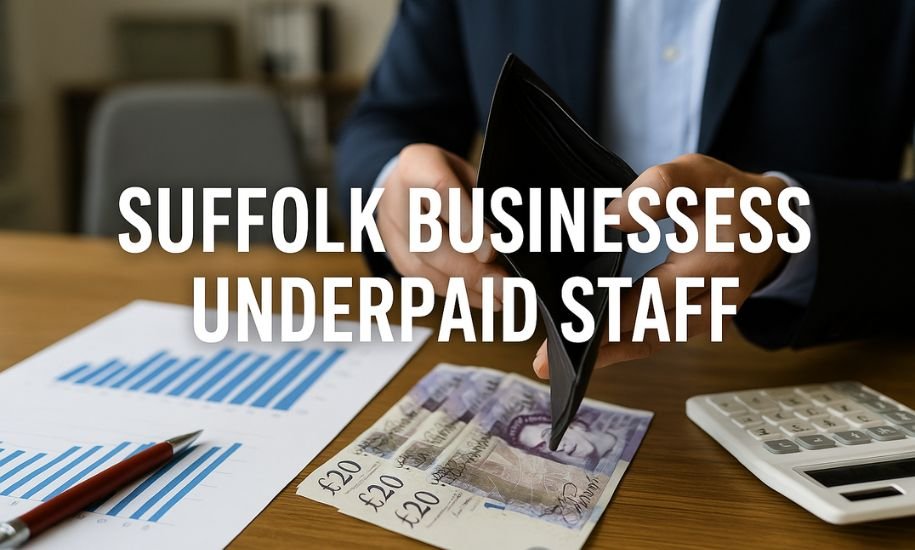
For years, the issue of wage underpayment has been a nationwide concern, but recent government enforcement activity has brought renewed attention to how the problem is playing out at a local level. Suffolk — home to a mix of independent retailers, agricultural employers, hospitality venues, logistics firms and service-sector businesses — has not been immune. A number of Suffolk-based employers have appeared in recent government “naming rounds,” where HMRC publicly lists companies found to have underpaid workers the National Minimum Wage (NMW) or National Living Wage (NLW).
While the scale of underpayment varies widely, the message from government is consistent: every worker, regardless of age, industry, or contract type, is entitled to be paid fairly, and every employer is responsible for getting pay calculations right.
This article examines how underpayment has emerged across Suffolk businesses, what the latest data shows, why underpayments happen, and how both workers and employers can respond.
A National Issue With Local Consequences
Across the UK, recent government enforcement rounds have revealed that hundreds of employers — from large household names to Small Local Businesses — have collectively underpaid millions of pounds to thousands of staff. In one widely reported naming round, the government publicly identified more than 500 employers across the country who owed nearly £16 million in unpaid wages.
Suffolk businesses have appeared among these named employers. These cases, while usually involving smaller local firms rather than large chains, illustrate that wage underpayment is not limited to major corporations — it affects communities, small towns, and everyday workplaces.
Local mentions in Suffolk have included convenience stores, garages, salons, hospitality venues and small service businesses, reflecting the county’s economic makeup. In some cases, a single error in payroll software led to years of unpaid hours; in others, misunderstanding of rules around uniforms, training time, or apprentice rates caused staff to receive less than they were legally owed.
It is important to note that the government’s naming lists do not distinguish between intentional underpayment and accidental payroll error — both result in the employer being named publicly once HMRC completes its investigation. For workers, however, the outcome is the same: lost income that must be repaid.
Common Reasons Suffolk Businesses Underpaid Staff Pay
Analysis of UK-wide investigations shows several recurring themes that also apply to Suffolk businesses. Most underpayments stem not from deliberate exploitation, but from avoidable mistakes:
1. Incorrect Uniform Deductions
If a business requires employees to buy clothing (such as aprons, branded shirts, shoes, or protective equipment), those costs cannot reduce pay below the minimum wage. Many independent Suffolk retailers and hospitality businesses fall into this trap unintentionally.
2. Unpaid Working Time
A frequent cause of underpayment occurs when employers fail to compensate staff for:
- Opening or locking up the premises
- Mandatory training
- Time spent preparing equipment
- Travel time between work locations
In sectors like care, cleaning and delivery — all active in Suffolk — this is a common oversight.
3. Misapplying Age-Related Wage Rates
Businesses sometimes keep staff on a lower wage band after a birthday, especially when payroll is handled manually. Apprenticeship rates are another source of confusion, particularly for small Suffolk businesses with part-time apprentices.
4. Incorrect Deductions or Admin Errors
Seemingly small payroll mistakes can snowball over months or years, resulting in significant underpayments by the time HMRC performs a review.
While intentions vary, the law remains clear: employers must pay staff at least the correct legal minimum for every hour worked, and HMRC will enforce repayment regardless of the cause of the shortfall.
Impact on Suffolk’s Workforce and Local Economy
Wage underpayment disproportionately affects lower-income workers — often those in part-time, shift-based or seasonal roles. Suffolk has a high proportion of workers in hospitality, retail, agriculture and logistics, sectors where minimum-wage pay is common.
Underpayment harms both workers and the wider community:
- Workers face financial insecurity — particularly challenging given the rising cost of living across East Anglia.
- Local businesses lose trust within their communities when named publicly, even if errors were unintentional.
- Competitors are put at a disadvantage, as compliant employers bear higher staff costs than those who have been underpaying.
However, the naming scheme also has positive outcomes: it leads to reimbursement, improves payroll compliance, and encourages employers to modernise their wage-calculation processes.
How HMRC Enforces Wage Compliance in Suffolk
HMRC conducts investigations following:
- Worker complaints
- Intelligence from unions and advisory bodies
- Random compliance checks
- Data-matching and algorithm-based risk analysis
When underpayment is found:
- Employers must repay all arrears (back pay is calculated at current minimum wage rates, so workers receive more than originally owed).
- Businesses can face penalties of up to 200% of the underpayment amount.
- In serious or repeated cases, criminal proceedings are possible, though rare.
- The employer may be publicly named in the government’s periodic “naming rounds.”
Suffolk businesses included in the naming scheme have typically fallen into the categories mentioned earlier: small retailers, food-based businesses, service providers and garages. While some immediately corrected their errors and cooperated with enforcement, others faced substantial penalties.
The Reality for Suffolk Employers: Compliance Challenges
Running a small business in Suffolk involves juggling rising costs, staffing challenges, and administrative demands. Many employers under investigation have stated that payroll complexity — not deliberate wrongdoing — led to the errors.
Common employer challenges include:
- Limited administrative staff
- Outdated payroll systems
- Lack of clarity around minimum wage rules
- Misinterpretation of deductions and allowances
- Difficulty tracking working hours accurately
However, government guidance is widely available, and HMRC expects employers to keep accurate digital or written records. The law does not excuse mistakes due to size or confusion.
What Suffolk Workers Should Do if They Suspect Underpayment
Workers in Suffolk who believe they have been underpaid can:
- Use the GOV.UK “Check Your Pay” tool to confirm the correct minimum or living wage.
- Raise the issue internally — sometimes an employer will correct the issue immediately.
- Report anonymously to HMRC if they fear retaliation.
- Seek advice from ACAS or local employment-rights organisations.
HMRC investigations are confidential, and employers are not notified of the identity of complainants.
What Suffolk Employers Can Do to Ensure Compliance
To avoid appearing on future naming lists, Suffolk businesses should:
- Review payroll software and ensure it is up to date.
- Conduct internal audits of working hours.
- Keep precise records for apprentices, young workers and staff on varied shifts.
- Reimburse any uniform or equipment costs properly.
- Periodically consult payroll professionals or legal advisors.
Complying with wage laws not only protects workers — it protects a business’s reputation, especially in smaller communities where trust is essential.
Why This Matters for Suffolk’s Future
Suffolk continues to grow as a region of entrepreneurial activity, with thriving local industries and expanding business hubs. Ensuring that workers are paid fairly strengthens the county’s economic foundation and prevents reputational harm to sectors that rely heavily on community support.
As HMRC continues rigorous enforcement, wage compliance will become an increasingly important part of responsible business practice. Suffolk employers have much to gain by investing in proper payroll processes, and Suffolk workers have every right to expect accurate and lawful pay.
Conclusion
The issue of Suffolk businesses underpaying staff is part of a broader national pattern — but one with distinct local implications. While many underpayments arise from genuine mistakes, they still impact workers’ livelihoods and lead to significant penalties. Increased awareness, better payroll systems and stronger guidance can help Suffolk reduce the number of businesses appearing in future naming rounds.
For more commentary, analysis and English-language articles on UK employment and business topics, visit CharFen.co.uk.
Also Visit us: Junk Be Gone Disposal LTD. Vancouver Reviews: Full Customer Insight & Owner Background
