


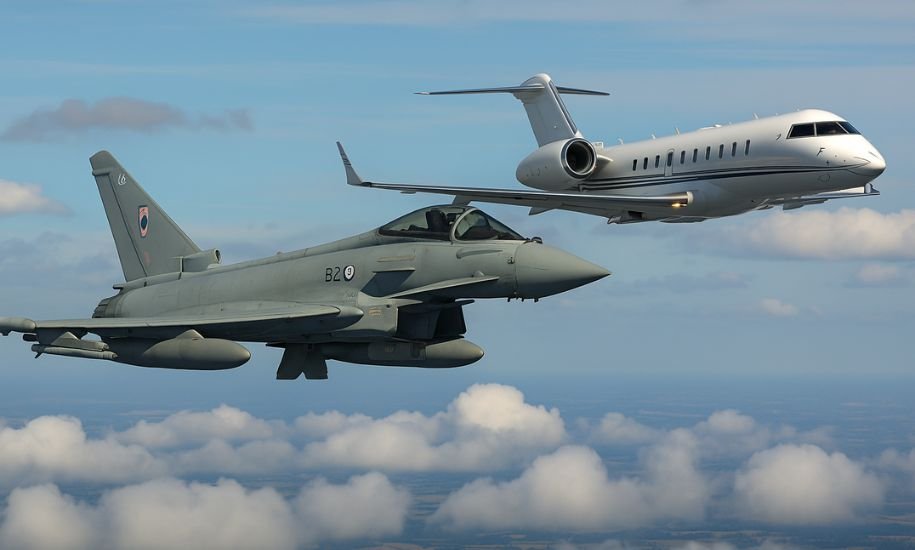
On the morning of 15 August 2025, residents across large parts of southeast England were startled by a loud, house-shaking boom that echoed through the skies. Many wondered whether an explosion had occurred or whether a major structure had failed. In reality, the noise was the result of a rapid and highly coordinated military response. The event, widely discussed by aviation analysts and the public, quickly became known under the headline: “RAF Typhoon Intercepts Business Jet.”
The incident began when a private business aircraft travelling from Nice toward London lost communication with air traffic controllers. That loss of radio contact triggered the United Kingdom’s Quick Reaction Alert system — the defence protocol that ensures any aircraft operating abnormally in or near UK airspace is swiftly investigated. Within minutes, RAF Typhoon fighter jets were launched to intercept the unresponsive aircraft.
How the Incident Unfolded
The business jet, identified as a long-range Bombardier Global variant, was cruising at high altitude when controllers attempted routine communication checks. When the aircraft failed to respond on designated frequencies, the RAF initiated its rapid-response procedure. Fighters from RAF Coningsby, one of Britain’s key air defence bases, were scrambled to approach, identify, and visually assess the situation.
As the Typhoons climbed steeply and accelerated to interception speed, one aircraft exceeded the speed of sound, producing the unmistakable sonic boom heard by residents on the ground. Because modern military jets rarely break the sound barrier over populated regions — largely due to noise regulations — the boom surprised thousands across counties including Essex, Suffolk, Kent, Cambridgeshire, and parts of Greater London.
For many who heard it, the noise was described as a single, powerful “explosive crack,” reverberating through windows, walls, and streets. Social media quickly filled with speculation: Was it an explosion? A meteor? A major accident? Within the hour, the Ministry of Defence confirmed the real cause: RAF Typhoon intercepts business jet due to temporary loss of communication.
The Typhoon: A Fighter Built for Rapid Response
The Eurofighter Typhoon is one of the fastest, most agile multirole fighter aircraft in service today. With a top speed above Mach 2, advanced radar systems, and precision tracking capabilities, it is specifically designed to respond in scenarios where rapid identification is essential.
During a Quick Reaction Alert mission, time is critical. If an aircraft cannot be contacted, the fighters must reach it as quickly as safety allows. This is why a Typhoon may accelerate through the sound barrier — compressing air into a high-energy shockwave that releases as a sonic boom. In this case, the need to visually confirm the status of the business jet outweighed typical noise restrictions, and the fighters closed the distance in minutes.
The sight of two Typhoons forming up alongside the business jet — one moving ahead to identify its cockpit and another maintaining a tracking position — would have been dramatic, though largely unseen by the public below.
What Happened Once the Business Jet Was Intercepted
Once the intercepting Typhoons reached the business jet, they conducted a series of standard visual checks. These include assessing whether the cockpit crew is alert, whether the aircraft appears damaged, and whether any unusual activity is visible.
Shortly after contact was made, communication with the aircraft was reportedly restored. The flight crew indicated no emergency situation, suggesting the earlier silence was likely due to technical malfunction or incorrect frequency selection — both issues that have triggered similar military responses in the past.
The Typhoons then shifted from interception to escort mode, accompanying the business jet to London Stansted Airport, a common diversion site for unexpected or security-sensitive arrivals. After landing, the aircraft was met by authorities who confirmed that there was no threat and no cause for concern.
Public Reaction and Confusion Caused by the Sonic Boom
The loud boom generated by the supersonic Typhoon became the most publicly noticeable element of the entire operation. Residents described pets panicking, buildings shaking, and a startling shockwave that, for many, was unlike anything they had heard before.
Because commercial airliners never break the sound barrier and military jets seldom do so over land, sonic booms are rare in the UK. Many younger residents had never experienced one at all. In community discussions online, the event became a fascination point — leading many to search terms like “RAF Typhoon Intercepts Business Jet” to understand what had happened.
For defence experts, however, the event illustrated a textbook example of national air policing and the importance of swift defence measures. It also served as a reminder of how sensitive the country’s airspace security system is, quickly detecting even minor anomalies in radio communication.
Why the RAF Responds So Quickly: Understanding Air Policing Protocols
The UK’s air defence system constantly monitors civilian and military flight patterns. When controllers lose contact with an aircraft, the situation is treated seriously until proven otherwise. There are several reasons communication can be lost:
- Equipment failure
- Incorrect radio frequency settings
- Pilot distraction or workload
- Software or navigation abnormalities
- Sudden medical issues in the cockpit
While most incidents resolve uneventfully, aviation history shows that loss of communication can, in rare circumstances, signal a more serious emergency — such as depressurisation, loss of consciousness, or hijacking. For this reason, the RAF must assume the highest risk until visual confirmation is made.
This is why incidents like RAF Typhoon intercepts business jet are not unusual from a defence standpoint. They are routine — but highly visible — reminders that airspace security teams stand ready around the clock.
The Intersection of Military and Civil Aviation
The skies are shared by private jets, commercial airliners, military aircraft, cargo planes, and helicopters. As the volume of global air travel increases, the complexity of monitoring and responding to unusual flight behaviour grows as well. Interceptions, while uncommon from the public perspective, are a critical safety tool.
The collaboration between civilian air traffic control and RAF QRA units ensures:
- National sovereignty is protected
- Potential dangers are identified early
- Civilian air routes remain safe and regulated
- Pilots experiencing technical failures receive support
In many ways, the event reinforced how interconnected civilian and military aviation have become. Even the smallest miscommunication can trigger a coordinated national response — and that is a sign of a healthy, vigilant air defence system.
Lessons and Takeaways From the Incident
The RAF Typhoon intercepts business jet incident underscores several key points:
- The UK’s air defence network works quickly and effectively.
Fighters were airborne within minutes and reached the aircraft in time to determine its safety. - Sonic booms, while startling, are sometimes necessary.
They indicate rapid military action, not an uncontrolled event. - Communication reliability in aircraft is essential.
Even minor radio issues can lead to major responses to ensure safety. - The RAF maintains strong air policing abilities.
These capabilities protect both the public and national airspace integrity. - Public awareness of air defence operations remains low.
Events like this highlight the need for greater understanding of military-civilian aviation coordination.
In the end, the situation concluded safely — a testament to well-trained pilots, responsive air defence units, and strict aviation safety standards.
Final Thoughts
The RAF Typhoon Intercepts Business Jet incident of August 2025 will be remembered not for danger, but for efficiency. It showcased the professionalism of RAF pilots, the sophistication of the UK’s air defence network, and the importance of rapid response procedures. While the sonic boom may have startled thousands, the mission’s clean outcome demonstrates precisely why such systems exist: to keep the skies safe, the public informed, and emergencies under control.
Article by: CharFen.co.uk
Junk Be Gone Disposal LTD. Vancouver Reviews: Full Customer Insight & Owner Background
